The Definitive Ranking of the World’s Fastest Cars in 2026
In the ever-evolving landscape of automotive engineering, the pursuit of speed remains one of the most captivating and challenging frontiers. Each year, manufacturers push the boundaries of what’s possible, blending cutting-edge technology with raw power to create machines that blur the line between road car and rocket. The quest for the title of “world’s fastest” isn’t just about bragging rights; it’s a testament to human ingenuity, aerodynamic mastery, and the relentless drive to achieve the seemingly impossible.
For enthusiasts and industry insiders, the fastest cars in the world represent the pinnacle of automotive achievement. These vehicles combine breathtaking acceleration, precision engineering, and often, a level of exclusivity that places them in a league of their own. As we delve into 2026, the competition has reached a fever pitch, with established titans and ambitious newcomers vying for supremacy on both the road and the track.
This comprehensive guide will explore the elite echelon of hypercars that define the current era of speed. We’ll analyze not only their staggering top speeds but also the technologies that enable these feats, the engineering challenges overcome, and the practical considerations that separate a true world-beater from a mere contender. Whether you’re a die-hard petrolhead or simply fascinated by the extremes of automotive performance, this is your ultimate resource for the fastest cars of 2026.
The Metrics That Matter: Defining “Fastest”
Before we crown the kings of speed, it’s crucial to understand how we measure these phenomenal machines. The term “fastest” can be interpreted in several ways, and a true contender must excel in multiple categories.
Top Speed: This is the headline figure—the maximum velocity a car can achieve under ideal conditions. It’s the ultimate benchmark, often verified through official runs on closed courses like the Bonneville Salt Flats or the Ehra-Lessien test track. For a record to be widely accepted, it typically requires a two-way average to account for wind and gradient variations, though single-direction runs still capture headlines.
Acceleration: A car can have a stratospheric top speed, but if it takes an eternity to get there, it lacks everyday usability. Acceleration metrics, usually measured as 0-60 mph (0-96 km/h) or 0-100 km/h (0-62 mph), quantify how quickly a car can build speed from a standstill. In the realm of hypercars, these numbers are often measured in the low two-second range, rivaling the fastest dragsters.
Track Performance: Real-world speed isn’t just about straight-line velocity. A car’s ability to navigate corners at high G-forces is equally important. Lap times on iconic circuits like the Nürburgring Nordschleife provide a comprehensive picture of a car’s handling, braking, and aerodynamic efficiency. The fastest production cars of 2026 are often capable of setting lap times that rival professional race cars.
Practicality: While the primary focus is on extreme performance, the best hypercars in 2026 also strike a delicate balance between usability and track readiness. Factors like ground clearance, suspension adjustability, and ease of driving in traffic determine whether a car is a one-dimensional speed machine or a truly livable exotic.
The Contenders: 2026’s Elite Speed Machines
Koenigsegg Jesko Absolut: The Reigning King
Swedish manufacturer Koenigsegg has long been a dominant force in the quest for ultimate speed, and the Jesko Absolut represents the culmination of their engineering philosophy. Named after the late father of company founder Christian von Koenigsegg, the Absolut is designed with one purpose: to be the fastest production car ever made.
Under the hood lies a 5.0-liter twin-turbo V8 engine that produces a staggering 1,600 horsepower when running on E85 biofuel. This power is routed through Koenigsegg’s revolutionary 9-speed Light Speed Transmission (LST), which eliminates traditional gears in favor of a continuously variable planetary gearset. This allows for near-instantaneous gear changes and optimal power delivery at any speed.
Aerodynamically, the Jesko Absolut is a masterpiece of efficiency. Koenigsegg engineers spent hundreds of hours in CFD (Computational Fluid Dynamics) simulations to perfect its shape, achieving an incredibly low drag coefficient of just 0.278 Cd. The car features a smooth, teardrop-like profile with a long rear tail and covered rear wheels to minimize turbulence. While Koenigsegg has yet to conduct an official top-speed run, simulations predict a theoretical top speed of over 330 mph (531 km/h). If realized, this would shatter all existing records.
Bugatti Chiron Super Sport 300+: The Record Breaker
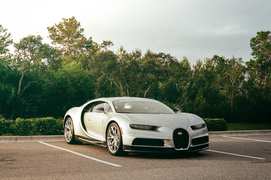
Bugatti, the French marque synonymous with speed, claimed the title of the first production car to break the 300 mph barrier with the Chiron Super Sport 300+. During a test run at Volkswagen’s Ehra-Lessien facility in 2019, a pre-production prototype achieved a verified two-way average of 273.4 mph (440 km/h), though the one-way top speed reached an astonishing 304.77 mph (490.48 km/h).
The Super Sport 300+ is powered by Bugatti’s legendary quad-turbocharged 8.0-liter W16 engine, producing 1,600 horsepower and 1,180 lb-ft of torque. To achieve its record-breaking speed, the car was modified with a longer rear tail to reduce drag, revised aerodynamics, and a higher top gear ratio. While production models are electronically limited to 273 mph for safety reasons, the Super Sport 300+ remains a benchmark in the hypercar landscape.
SSC Tuatara: The Claimed Champion
SSC (Shelby SuperCars) North America’s Tuatara has had a tumultuous journey in its pursuit of the world record. After an initial controversial claim of a 331 mph average speed in 2020, subsequent tests and data analysis revealed discrepancies, casting doubt on the achievement. However, SSC has continued to refine the car and conduct rigorous testing.
The Tuatara is powered by a 5.9-liter twin-turbocharged V8 engine that can produce up to 1,750 horsepower on E85 fuel. Its aerodynamic design is optimized for high-speed stability, with a drag coefficient of 0.279 Cd. In October 2022, the Tuatara achieved a verified two-way average of 295 mph (474.8 km/h), making it one of the fastest production cars in the world. With further development, SSC aims to push the Tuatara even faster, potentially reclaiming the title for the United States.
Hennessey Venom F5: The American Contender
Hennessey Performance Engineering, based in Texas, has a long history of tuning and modifying high-performance vehicles. The Venom F5 represents their first ground-up hypercar, designed specifically to challenge the world’s fastest. The name “F5” refers to the F5 category of tornado, the most powerful wind speed on the Fujita scale, symbolizing the car’s extreme performance.
At its heart is a 6.6-liter twin-turbocharged V8 engine dubbed “Fury,” which produces an astonishing 1,817 horsepower and 1,193 lb-ft of torque. The car weighs just 1,385 kg (3,055 lbs), thanks to an extensive use of carbon fiber. Hennessey has tested the Venom F5 at the Johnny Bohmer Proving Grounds in Florida, where it has reached speeds in excess of 270 mph. The company is confident that the Venom F5 can exceed 300 mph, with simulations predicting a top speed of 311 mph (500 km/h).
Rimac Nevera: The Electric Benchmark
The Rimac Nevera has redefined what’s possible with electric hypercars. Developed by Croatian company Rimac Automobili, the Nevera is a technological tour de force that combines blistering performance with everyday usability. It features four independent electric motors, one at each wheel, providing precise torque vectoring and all-wheel drive.
The Nevera’s powertrain produces a combined 1,914 horsepower and 1,741 lb-ft of torque, allowing it to accelerate from 0-60 mph in a mind-bending 1.74 seconds. Its top speed is electronically limited to 258 mph (412 km/h), which, while lower than some gasoline-powered competitors, is achieved with instant torque and silent operation. The Nevera holds numerous performance records, including the fastest 0-200-0 km/h time for a production EV, completing the feat in just 10.3 seconds.
McLaren Speedtail: The Grand Tourer Approach
McLaren’s Speedtail takes a different approach to high performance. Rather than focusing solely on top speed, McLaren aimed to create the ultimate grand tourer, combining velocity with comfort and style. The Speedtail features a unique three-seat configuration with the driver positioned in the center, reminiscent of the classic McLaren F1.
Power comes from a hybrid powertrain that combines a 4.0-liter twin-turbocharged V8 with an electric motor, producing a combined 1,028 horsepower. The Speedtail’s design is its most striking


 The Definitive Ranking of the World’s Fastest Cars in 2026
In the ever-evolving landscape of automotive engineering, the pursuit of speed remains one of the most captivating and challenging frontiers. Each year, manufacturers push the boundaries of what’s possible, blending cutting-edge technology with raw power to create machines that blur the line between road car and rocket. The quest for the title of “world’s fastest” isn’t just about bragging rights; it’s a testament to human ingenuity, aerodynamic mastery, and the relentless drive to achieve the seemingly impossible.
For enthusiasts and industry insiders, the fastest cars in the world represent the pinnacle of automotive achievement. These vehicles combine breathtaking acceleration, precision engineering, and often, a level of exclusivity that places them in a league of their own. As we delve into 2026, the competition has reached a fever pitch, with established titans and ambitious newcomers vying for supremacy on both the road and the track.
This comprehensive guide will explore the elite echelon of hypercars that define the current era of speed. We’ll analyze not only their staggering top speeds but also the technologies that enable these feats, the engineering challenges overcome, and the practical considerations that separate a true world-beater from a mere contender. Whether you’re a die-hard petrolhead or simply fascinated by the extremes of automotive performance, this is your ultimate resource for the fastest cars of 2026.
The Metrics That Matter: Defining “Fastest”
Before we crown the kings of speed, it’s crucial to understand how we measure these phenomenal machines. The term “fastest” can be interpreted in several ways, and a true contender must excel in multiple categories.
Top Speed: This is the headline figure—the maximum velocity a car can achieve under ideal conditions. It’s the ultimate benchmark, often verified through official runs on closed courses like the Bonneville Salt Flats or the Ehra-Lessien test track. For a record to be widely accepted, it typically requires a two-way average to account for wind and gradient variations, though single-direction runs still capture headlines.
Acceleration: A car can have a stratospheric top speed, but if it takes an eternity to get there, it lacks everyday usability. Acceleration metrics, usually measured as 0-60 mph (0-96 km/h) or 0-100 km/h (0-62 mph), quantify how quickly a car can build speed from a standstill. In the realm of hypercars, these numbers are often measured in the low two-second range, rivaling the fastest dragsters.
Track Performance: Real-world speed isn’t just about straight-line velocity. A car’s ability to navigate corners at high G-forces is equally important. Lap times on iconic circuits like the Nürburgring Nordschleife provide a comprehensive picture of a car’s handling, braking, and aerodynamic efficiency. The fastest production cars of 2026 are often capable of setting lap times that rival professional race cars.
The Definitive Ranking of the World’s Fastest Cars in 2026
In the ever-evolving landscape of automotive engineering, the pursuit of speed remains one of the most captivating and challenging frontiers. Each year, manufacturers push the boundaries of what’s possible, blending cutting-edge technology with raw power to create machines that blur the line between road car and rocket. The quest for the title of “world’s fastest” isn’t just about bragging rights; it’s a testament to human ingenuity, aerodynamic mastery, and the relentless drive to achieve the seemingly impossible.
For enthusiasts and industry insiders, the fastest cars in the world represent the pinnacle of automotive achievement. These vehicles combine breathtaking acceleration, precision engineering, and often, a level of exclusivity that places them in a league of their own. As we delve into 2026, the competition has reached a fever pitch, with established titans and ambitious newcomers vying for supremacy on both the road and the track.
This comprehensive guide will explore the elite echelon of hypercars that define the current era of speed. We’ll analyze not only their staggering top speeds but also the technologies that enable these feats, the engineering challenges overcome, and the practical considerations that separate a true world-beater from a mere contender. Whether you’re a die-hard petrolhead or simply fascinated by the extremes of automotive performance, this is your ultimate resource for the fastest cars of 2026.
The Metrics That Matter: Defining “Fastest”
Before we crown the kings of speed, it’s crucial to understand how we measure these phenomenal machines. The term “fastest” can be interpreted in several ways, and a true contender must excel in multiple categories.
Top Speed: This is the headline figure—the maximum velocity a car can achieve under ideal conditions. It’s the ultimate benchmark, often verified through official runs on closed courses like the Bonneville Salt Flats or the Ehra-Lessien test track. For a record to be widely accepted, it typically requires a two-way average to account for wind and gradient variations, though single-direction runs still capture headlines.
Acceleration: A car can have a stratospheric top speed, but if it takes an eternity to get there, it lacks everyday usability. Acceleration metrics, usually measured as 0-60 mph (0-96 km/h) or 0-100 km/h (0-62 mph), quantify how quickly a car can build speed from a standstill. In the realm of hypercars, these numbers are often measured in the low two-second range, rivaling the fastest dragsters.
Track Performance: Real-world speed isn’t just about straight-line velocity. A car’s ability to navigate corners at high G-forces is equally important. Lap times on iconic circuits like the Nürburgring Nordschleife provide a comprehensive picture of a car’s handling, braking, and aerodynamic efficiency. The fastest production cars of 2026 are often capable of setting lap times that rival professional race cars.