The 10 Fastest Cars in the World of 2026: A New Benchmark for Speed
Vagif GadimovBY Vagif Gadimov
October 22, 2024 6:28 am
The landscape of high-performance automobiles continues to evolve at a breakneck pace, captivating automotive enthusiasts, engineers, and industry insiders alike with the relentless pursuit of speed. Modern fast cars represent far more than just impressive top velocities; they are the ultimate expression of automotive innovation, embodying cutting-edge technology, meticulously engineered powertrains, and aerodynamic designs that push the very boundaries of what is possible on four wheels. These remarkable machines blend the intoxicating thrill of extreme performance with an unparalleled level of prestige, making them the focal point of intense competition among manufacturers and the ultimate aspiration for collectors worldwide.
As we navigate the complexities of the 2026 automotive season, the question of which production vehicles currently hold the title of “fastest” continues to spark debate and rigorous verification. This comprehensive analysis delves into the world’s ten fastest cars, showcasing their astounding speed capabilities, acceleration metrics, and the engineering excellence that underpins their performance. Through a detailed examination of their specifications, real-world testing data, and emerging trends, we aim to provide a definitive ranking that reflects the very pinnacle of automotive achievement in this highly competitive field, setting a new benchmark for speed in the process.
Selection Criteria: The Science Behind the Numbers
To ensure accuracy and relevance in our ranking of the fastest cars in the world for 2026, we have established a rigorous set of criteria. These standards move beyond mere manufacturer claims to focus on verifiable data and real-world performance metrics that matter to serious automotive enthusiasts and industry professionals.
Verified Highest Speed: The primary benchmark for this list is the maximum speed a vehicle has achieved in documented, independent testing. This figure must be verifiable through credible automotive media outlets or official manufacturer tests, moving beyond theoretical projections to real-world results that can be replicated or substantiated.
Acceleration Metrics: Beyond top speed, we evaluate a vehicle’s 0–60 mph (0–100 km/h) acceleration times. This metric serves as a critical indicator of the car’s power delivery, traction, and overall performance efficiency during the initial phase of acceleration, showcasing the immediate impact of its powertrain.
Comprehensive Performance: This criterion encompasses a vehicle’s handling characteristics, aerodynamic stability at high speeds, and overall drivability. A car that is simply fast on a drag strip does not necessarily qualify; it must demonstrate control and composure at its peak velocity, ensuring a degree of confidence for the driver.
Practical Driving Performance: For a vehicle to be considered among the fastest in the world, it must also possess a degree of practicality. This includes factors such as road legality (meeting production car standards), reliability, and its suitability for use beyond a controlled test track. This ensures that the reported speeds have real-world relevance for discerning buyers.
The 2026 Rankings: A Deep Dive into Automotive Excellence
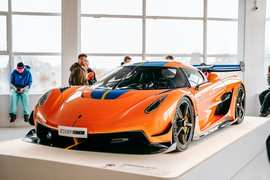
Koenigsegg Jesko Absolut – Exceeding 330 MPH (Projected)
Koenigsegg, the Swedish hypercar manufacturer renowned for its boundary-pushing engineering, continues to set the pace with the Jesko Absolut. This machine represents the zenith of the company’s pursuit of ultimate speed, combining a revolutionary powertrain with an aerodynamically optimized chassis. The heart of the Jesko Absolut is a bespoke 5.0-liter twin-turbocharged V8 engine that, when running on high-octane race fuel, unleashes a staggering 1,600 horsepower and 1,106 lb-ft of torque.
What truly sets the Jesko Absolut apart is its groundbreaking “Light Speed Transmission” (LST). This innovative nine-speed dual-clutch system eliminates the need for traditional fixed gears, allowing for instantaneous gear changes that maximize acceleration efficiency. With a claimed 0–60 mph time of just 2.5 seconds, the Jesko Absolut’s performance is nothing short of breathtaking. However, the most electrifying aspect of this hypercar is its projected top speed. While official real-world testing has yet to be conducted due to logistical challenges, simulations and engineering analysis indicate that the Jesko Absolut is capable of exceeding 330 mph, potentially making it the fastest production car ever built. Its sleek, droplet-shaped body, featuring a low drag coefficient of just 0.278, is a testament to Swedish engineering prowess, designed to slice through the air with minimal resistance.
Bugatti Chiron Super Sport 300+ – 304.77 MPH
The Bugatti Chiron Super Sport 300+, a limited-production successor to the legendary Veyron, etched its name in automotive history by being the first production-based car to break the 300 mph barrier. This monumental achievement was realized at Volkswagen’s Ehra-Lessien test track, where a prototype achieved a verified top speed of 304.77 mph (490.484 km/h). This milestone was accomplished using a modified version of the Chiron’s iconic quad-turbocharged 8.0-liter W-16 engine, boosted to produce 1,600 horsepower.
To achieve this extraordinary velocity, the Chiron Super Sport 300+ was extensively optimized for high-speed aerodynamics. The extended rear end, known as a “longtail,” reduces drag and improves stability at extreme speeds. Additionally, the vehicle’s suspension was lowered, and the gearing was recalibrated to favor top speed over acceleration. While the production version is electronically limited to 273 mph for safety reasons, the 304.77 mph run stands as a testament to Bugatti’s engineering capabilities and its dedication to pushing the boundaries of automotive performance. This feat continues to define the standard for hypercar development in the modern era.
SSC Tuatara – 295 MPH (Verified)
The SSC Tuatara, the brainchild of American supercar manufacturer SSC North America, represents a triumph of persistent engineering and a relentless pursuit of perfection. After a controversial initial claim in 2020, the company embarked on a meticulous re-testing process to validate its performance claims. The result is a production hypercar that has officially achieved a verified top speed of 295 mph (474.8 km/h), with a two-way average of 282.9 mph (455.3 km/h) to account for wind variation.
Powering this aerodynamic marvel is a custom-built 5.9-liter twin-turbocharged V8 engine derived from the Corvette C8’s LT5, developed in collaboration with Nelson Racing Engines. This powertrain produces an astonishing 1,350 horsepower on standard pump fuel and an incredible 1,750 horsepower when running on E85 ethanol. The Tuatara’s design is a masterpiece of aerodynamic efficiency, featuring a drag coefficient as low as 0.279. Its carbon fiber monocoque chassis ensures a dry weight of just 2,750 pounds, contributing to its remarkable agility and speed. The SSC Tuatara’s verified performance solidifies its position as one of the fastest production cars in the world and a symbol of American automotive innovation.
Hennessey Venom F5 – 272 MPH (Current), 311 MPH (Target)
The Hennessey Venom F5, developed by Texas-based Hennessey Special Vehicles, is a hypercar engineered with a singular focus: to break the 300 mph barrier. Named after the F5 tornado, the most powerful category on the Fujita scale, this vehicle embodies extreme velocity and raw power. At its core lies a formidable 6.6-liter twin-turbocharged V8 engine, affectionately nicknamed “Fury,” which produces an earth-shattering 1,817 horsepower and 1,193 lb-ft of torque.
During preliminary testing at Johnny Bohmer Proving Grounds in Florida, the Venom F5 achieved a verified top speed of 271.6 mph (437 km/h) in 2022. However, this figure represents only a fraction of the car’s true potential. John Hennessey and his team are confident that the Venom F5 can exceed 311 mph (500 km/h), a goal they are actively pursuing in further high-speed validation runs. The car’s chassis is constructed from lightweight carbon fiber, resulting in a dry weight of just 2,998 pounds, which contributes to its exceptional power-to-weight ratio. With its aggressive aerodynamic design and blistering acceleration, the Hennessey Venom F5 represents the cutting edge of American hypercar engineering and is poised to redefine the limits of automotive speed in 2026.
Rimac Nevera – 256 MPH
The Rimac Nevera, produced by Croatian automotive manufacturer Rimac Automobili, represents the pinnacle of electric hypercar technology. This all-electric marvel redefines performance expectations for electric vehicles, showcasing that battery-powered machines can rival and even surpass their internal combustion counterparts in terms of speed and acceleration. The Nevera is powered by four independent electric motors, one for each wheel, delivering a combined output of 1,914 horsepower and 1,740 lb-ft of torque.
This immense power translates into mind-bending acceleration figures: the Nevera can sprint from 0 to 60 mph in a mere 1.85 seconds and complete the quarter-mile in an astonishing 8.25 seconds. Its top speed is electronically limited to 256 mph (412 km/h), though